NIPT
– for those who want early reassurance in pregnancy
We are approved by the Norwegian Directorate of Health and offer NIPT with results usually available within 4–7 working days.
You will receive follow-up care from experienced midwives throughout the entire process.
NIPT can be performed from 10+0 weeks of pregnancy.
Choose the examination based on how far along you are.
NIPT + Ultrasound, week 10+0 – 11+1
- Medical ultrasound examination
- Blood test (NIPT)
- Guidance before, during and after the test
- Images and video from the examination
NIPT + Early fetal anatomy ultrasound week 11+2–13+6
- Medical ultrasound examination
- Measurement of the nuchal translucency (NT)
- Assessment of the nasal bone
- Early assessment of the fetus’ development and anatomy
- Blood test (NIPT)
- Images and video from the examination
- Guidance before, during and after the test
NIPT + Ultrasound week 14+0 – throughout the rest of pregnancy
Includes:
- Medical ultrasound examination
- Assessment of the fetus’ development and anatomy
- Possibility to determine the baby’s sex (often possible, but not always)
- Blood test (NIPT)
- Guidance before, during and after the test
- Images and video from the examination
Price: NOK 6,990
Why choose us?
We understand that this is an important examination for many during pregnancy.
That is why we place great emphasis on both medical quality and reassuring follow-up care.
Fast results
You will usually receive your results within 4–7 working days.
Thorough medical examination
At our clinic, ultrasound is always a medical assessment of the fetus’ development – not just a "quick check."
Follow-up throughout the process
You will receive guidance before, during and after the examination.
Everything in one place in Norway
There is no need to travel abroad for testing and further follow-up.
Ultrasound in week 14–16: possibility to determine the baby’s gender
Many parents wish to know the baby’s sex early in pregnancy, and some choose to travel abroad for this.
We aim to make it easier to have both the examination and follow-up in one place here in Norway.
At our clinic, ultrasound is always a medical examination where we assess the fetus’ development, anatomy and well-being.
It is usually possible to determine the baby’s sex from week 14+0 as part of the examination.
For patients who choose NIPT with us, we therefore offer an ultrasound from week 14+0–16+0 at a reduced price: NOK 890.
Is there a difference between NIPT tests?
Providers offering NIPT in Norway must be approved by the Norwegian Directorate of Health and meet strict requirements for quality and safety.
Modern NIPT tests generally have very high accuracy and a very low false-positive rate. For most people, the main difference lies in how quickly results are provided and how patients are supported before and after the test.
At our clinic, we place particular emphasis on this – offering fast results and thorough follow-up throughout the entire process.
What is NIPT?
Non-Invasive Prenatal Test (NIPT) is an advanced screening test that involves a simple blood sample. This test is used to assess the likelihood of chromosomal abnormalities, which can lead to serious birth defects in the child.
In Norway, NIPT tests for:
Trisomy 21 (Down syndrome)
Trisomy 18 (Edwards syndrome)
Trisomy 13 (Patau syndrome)
How does the test work?
During pregnancy, the mother's blood contains fragments of the fetus' DNA. This genetic material is believed to originate from cells in the placenta that embed in the uterine wall, allowing them to mix with the mother's bloodstream. Since the placenta shares the same genetic origin as the fetus, it generally carries the same chromosomal information. This means that, in principle, all genetic material (DNA) can be analyzed before the baby is born.

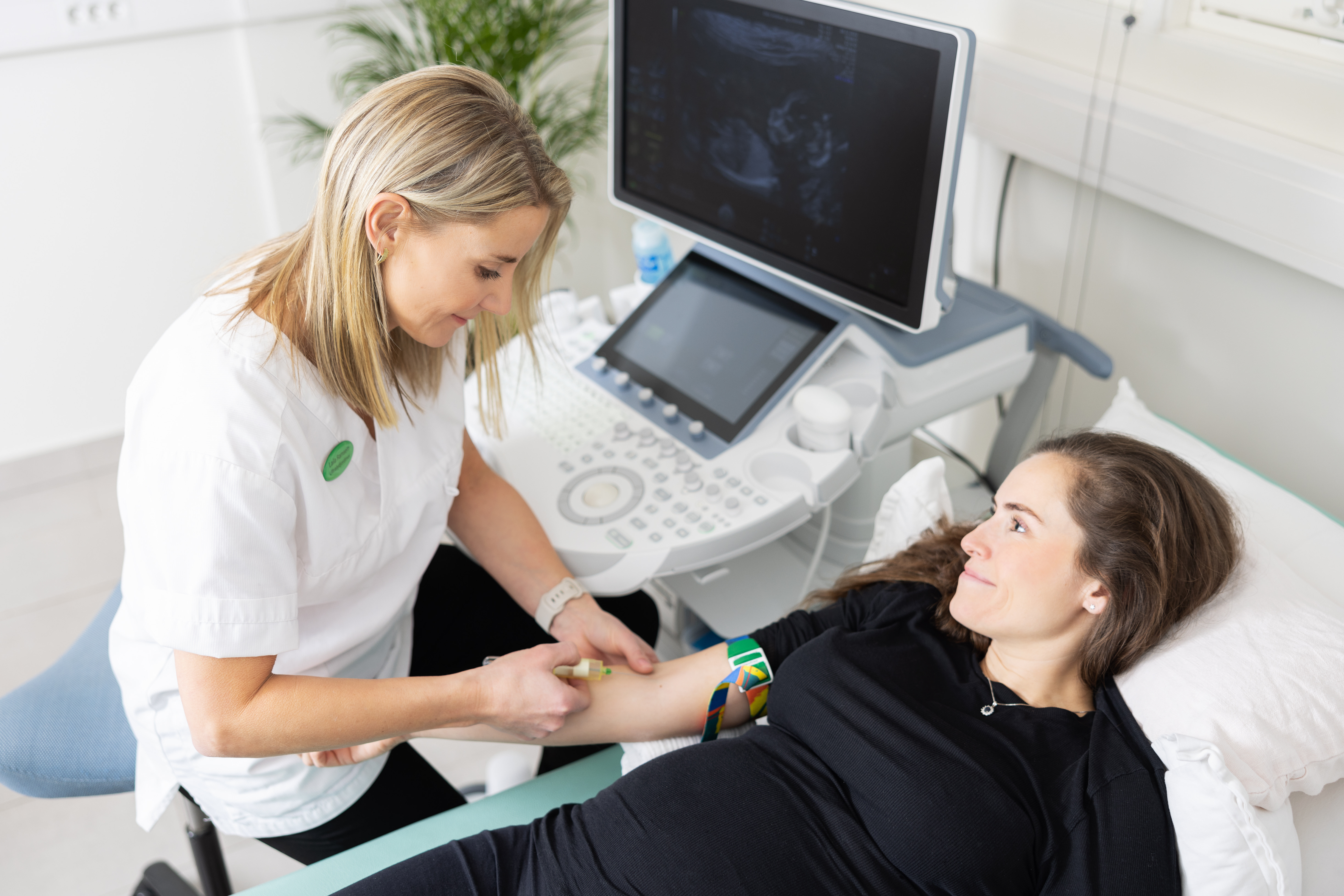
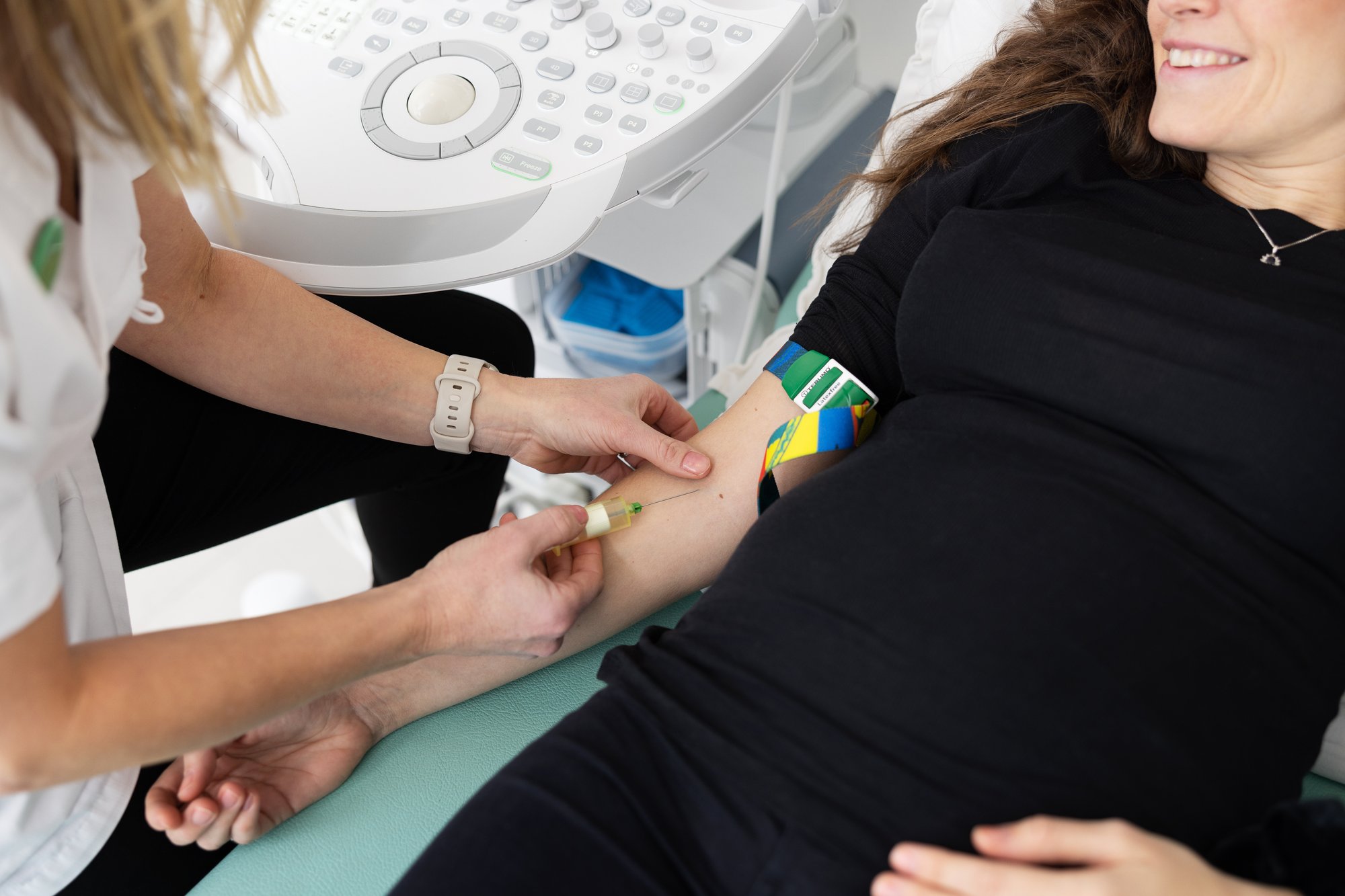
The blood sample is taken from the mother’s arm and can be performed from 10+0 weeks of pregnancy and onwards.
NIPT is performed in combination with an ultrasound examination.
NIPT can also be performed in twin pregnancies at our clinic.

NIPT and ultrasound
We perform NIPT in combination with an ultrasound examination. The ultrasound is usually performed abdominally, meaning on the outside of the abdomen. In some cases, a vaginal ultrasound examination may be necessary due to the position of the uterus.
The ultrasound examination performed together with NIPT is necessary to confirm fetal heartbeat, determine the number of fetuses, measure the CRL (crown–rump length), and estimate the gestational age.
NIPT provides information about trisomies 13, 18 and 21, but does not assess the fetus’ organs or anatomy. We therefore recommend a detailed ultrasound examination between weeks 12–14, with the purpose of assessing whether the fetus’ development and anatomy appear normal at this stage of pregnancy.
Ultrasound and NIPT are different methods that complement each other and together increase the reliability of fetal assessment.
NIPT test results
Results are usually available within 4–7 working days.
Your test results will be sent to you through secure login with BankID, or by post if you prefer.
If the NIPT result is inconclusive or if there is insufficient fetal DNA in the sample, you will be contacted by us by telephone. In rare cases, it may be necessary to repeat the test at no additional cost.
If the NIPT result indicates a high probability of trisomy 13, 18 or 21, the pregnant woman will be referred to the Department of Fetal Medicine at Rikshospitalet for a new ultrasound examination and an invasive diagnostic test in order to confirm or rule out the suspected condition. In such cases, we will contact the patient by telephone with the test results.
A positive test result may present difficult choices. In Norway, abortion is available on request up to week 18 of pregnancy. After this, termination may be granted following an application to an abortion committee, depending on the severity of the condition.
The woman is not required to terminate the pregnancy, regardless of the findings. She will always decide herself what is the right choice for her.
Additional information about NIPT at our clinic
It is important that you complete the NIPT School before your appointment with us. This provides the necessary information about what a NIPT test involves, its limitations, and is also required in order for you to receive your test results automatically.
The blood sample will be completely destroyed after the test results are available and the patient has been informed. This means that no additional analyses can be performed.
In the public healthcare system, existing national guidelines for fetal diagnostics and NIPT testing apply. You can read more about these here.
More information about fetal diagnostics and NIPT:
https://www.helsenorge.no/undersokelse-og-behandling/fosterdiagnostikk/
FAQ about NIPT
What is a NIPT test?
NIPT stands for Non-Invasive Prenatal Test. It is a blood test used to assess the risk of chromosomal abnormalities in the fetus, such as trisomy 21 (Down syndrome), trisomy 18 (Edwards syndrome), and trisomy 13 (Patau syndrome).
Do I have to do an ultrasound with NIPT? Can't I just take the blood test?
NIPT should be performed in conjunction with an early ultrasound starting from 10+0 weeks, or during a targeted organ ultrasound between weeks 12 and 14. This ensures confirmation of cardiac activity and the number of fetuses before the blood sample is taken.
What if I change my mind about doing NIPT during my appointment or if there are other reasons why the blood test cannot be taken?
If you order a NIPT test, but the blood test is nok taken for any reason during the consultation, you only get charged for the ultrasound.
Is it recommended to take the NIPT test at the hospital or at a private clinic?
There is no difference in the NIPT test itself, whether it is done at the hospital or with a private provider – both test for trisomy 13, 18, and 21. The difference lies in the timing of the test and the response time: At the hospital, the test is usually offered in conjunction with an ultrasound around weeks 12-14, with a response time of up to 14 business days. With us, however, you can take the test as early as week 10+0, and you will receive results within 4-7 business days.
How accurate is NIPT?
NIPT has a sensitivity of 95%-99%, while ultrasound has a sensitivity of 75%-85%. It is important to understand that these screening methods are complementary and do not exclude each other. NIPT and the ultrasound performed between weeks 12 and 14 are distinct techniques that, when used together, enhance the reliability of fetal examinations. If NIPT results indicate a high probability of chromosomal abnormalities, an invasive test is recommended to confirm or refute the NIPT findings. For such confirmatory testing, we refer patients to the fetal diagnostics department at Rikshospitalet.
In case of suspicion of illness or abnormalities, what happens next?
The midwives who perform ultrasound have completed one year of foetal diagnosis at the National Centre for Emergency Medicine at NTNU. If we see pictures that deviate from the normal we will refer the woman to a maternal-foetal medicine specialist at the National Hospital. She’ll then get an appointment within a few days.
.jpg?width=200&height=117&name=OJUK%20logo_m%20bindestrek%20(002).jpg)