.jpg?width=200&height=117&name=OJUK%20logo_m%20bindestrek%20(002).jpg "Oslo jordmor og ultralydklinikk")

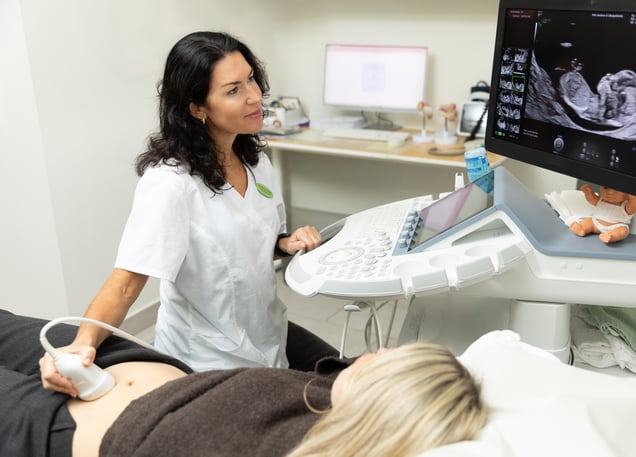
We offer early ultrasound from week 6
As certified ultrasound midwives, we are trained in "Early ultrasound" at the National Center for Fetal Medicine at NTNU and are also certified for "The 11-13 weeks scan" from the Fetal Medicine Foundation.
At Oslo Midwife and Ultrasound Clinic we offer different types of ultrasound examinations throughout the pregnancy. We want your visit at our clinic to be a personalized and pleasant experience. We allow ample time for the actual examination.
At the Oslo midwifery and ultrasound clinic, we offer ultrasounds for pregnant women, and we offer ultrasound examinations throughout pregnancy.
From early in pregnancy, we can use ultrasound to confirm pregnancy and to show the development of the fetus in the womb. For some, it is important to have the pregnancy confirmed as early as possible. As early as week 6-7, we can do an ultrasound to see if the heart is beating.
Early ultrasound is divided into two different ultrasound examinations based on the weeks of pregnancy and what can be seen:
-Ultrasound week 6 to 11
-Ultrasound week 11 to 14.
Read more below.

Ultrasound weeks 6-7
Before the first 6 completed weeks, the foetus has not developed enough, and we cannot therefore expect to see/hear a heartbeat. Few days play a big role in this context. If you book an appointment before the safe six weeks have passed, the examination might not be able to confirm a heartbeat.
Read more
Ultrasound week 11
The overall structure of the brain is now completed. From now on, the brain will further develop specialised structures. However, this does not mean that the brain is fully developed: important substructures in the rough division are not structurally present this early, and it is still a long time before the brain function as it would normally do.
Read more

Ultrasound 12-14
The risk of spontaneous abortion is now greatly reduced. Most miscarriages occur during the first 12 weeks of pregnancy. From now on, this is less common. The foetus's organs are now fully formed, and it is usually serious abnormalities in fetal development that cause the pregnancy to end in miscarriage before week 12.
Read more

FAQ
What is ultrasound?

2D (two-dimensional) ultrasound is sound waves that are transmitted from a probe into the body. The sound waves have such a high frequency that they’re inaudible to the human ear.
When the sound waves hit the body tissue, an echo occurs. The echo causes the sound waves to return to the sound head, which captures these sound signals.
After processing on a computer, the incoming audio signals appear as vivid images in black and white on a screen.
Is ultrasound dangerous?
Ultrasounds of pregnant women have been performed for more than 40 years. No adverse effects on women or foetuses have been recorded.
What happens if a missed abortion (MA) is detected at an early ultrasound?
Sometimes it happens that we do not see cardiac activity. This is usually due to a chromosomal abnormality.
We measure the embryo and refer the woman to the hospital she belongs to. Normally she will get an appointment in a few days. There, a gynaecologist will confirm the finding and a surgical or medical abortion will be performed.
The next day we send her a message to check in on her.
In case of suspicion of illness or abnormalities, what happens next?
The midwives who perform ultrasound have completed one year of foetal diagnosis at the National Centre for Emergency Medicine at NTNU. If we see pictures that deviate from the normal we will refer the woman to a maternal-foetal medicine specialist at the National Hospital. She’ll then get an appointment within a few days.
When is ultrasound done internally (vaginal), and on the stomach (abdominal)?
We perform ultrasound vaginally early in the pregnancy, that is, from weeks 6–12. This is because the embryo is so small and the pictures become much clearer on an internal ultrasound.
The woman must lie with her legs in the leg holder with a towel over her. Most people have no problems with this.
Occasionally we also do an internal ultrasound in week 12. This is if the woman has a uterus that is turned slightly backwards or if she’s overweight.
In the case of a 3D ultrasound, the examination is done abdominally.
What kind of ultrasound technology do you use?
We use the Voluson Expert 22 from GE HealthCare – one of the most advanced ultrasound systems available for women’s health and fetal imaging. The system is specifically designed for obstetric and gynecological ultrasound and combines exceptional image quality with modern AI-powered technology for highly precise and detailed examinations.
The machine delivers outstanding 2D, 3D, and 4D imaging, even in challenging scanning conditions, allowing for remarkable clarity and visualization of anatomical details. It is powered by GE HealthCare’s advanced Lyric Architecture technology, which provides faster processing, enhanced contrast, and superior resolution.
The Voluson Expert 22 also includes intelligent AI-assisted features that support more efficient and standardized examinations while improving diagnostic confidence and precision. This allows us to provide ultrasound examinations using state-of-the-art technology — ensuring the highest quality experience and care for our patients.